








Let me paint you a picture.
It’s late August. The farmer’s market is overflowing with eggplant, zucchini, tomatoes, and bell peppers in every color of the sunset. You’re sweating in your kitchen, wondering what on earth to do with all these vegetables before they go bad.
Enter: Ratatouille.
Now, I know what you’re thinking. You’re thinking of the Disney movie with the little rat chef. And yes, that’s adorable. But real ratatouille? It’s so much better. It’s the original “clean out your crisper drawer” recipe; a humble, rustic vegetable stew from the Provence region of France.
I first tasted ratatouille at a tiny bistro in Lyon on a rainy October evening. I ordered it because I needed something warm and vegetarian. What arrived was a bowl of vegetables that looked simple; almost too simple. But one bite? One bite and I understood why the French have been making this for generations.
The eggplant was silky. The zucchini was tender but not mushy. The bell peppers added sweetness, and the tomatoes tied everything together in a rich, savory broth. It was humble ingredients, treated with respect, turning into something extraordinary.
This recipe is my tribute to that bistro meal. It’s not fancy. It doesn’t require weird ingredients. But it does require a little patience; because the secret to great ratatouille is cooking each vegetable separately before braising them together.
Trust me. It’s worth it.
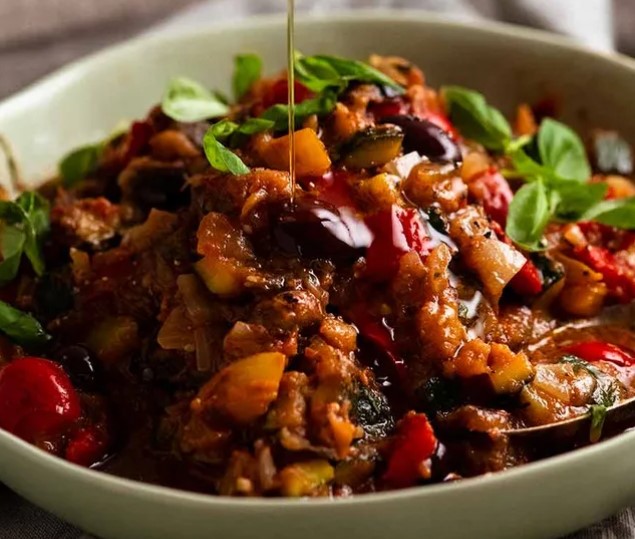
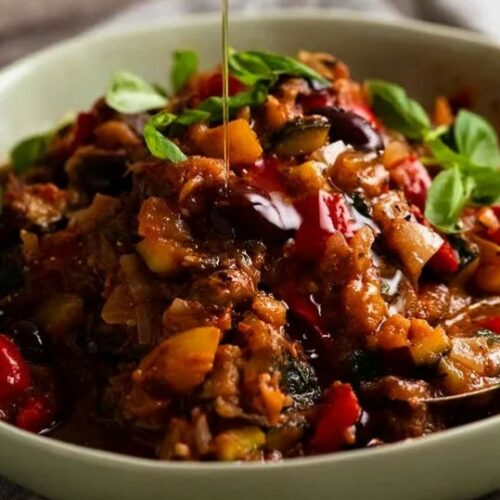
Flavor Profile: Savory and earthy from the eggplant, sweet from the bell peppers and tomatoes, with bright pops of brininess from the olives and freshness from the basil. The texture is where this dish shines; tender vegetables that still hold their shape, swimming in a thick, juicy sauce that begs to be sopped up with crusty bread.
Why You’ll Love This Ratatouille
Let me give you four reasons to make this today:
- One pot, big flavor. After some initial skillet work, everything simmers together in one pot. Minimal cleanup, maximum deliciousness.
- Vegetable heavy (in the best way). This is the kind of meal that makes you feel good. So much color, so much fiber, so much nutrition.
- Better the next day. Like all great stews, ratatouille’s flavors meld and deepen overnight. Make it ahead for an easy dinner.
- Incredibly versatile. Serve it as a main with bread, a side dish for roasted chicken, or even cold as a sandwich spread.
Expert Tips & Tricks
I’ve made ratatouille more times than I can count. Here’s what I’ve learned.
Success Tips:
- Don’t skip sweating the eggplant. This is non negotiable. Salting the eggplant and letting it sit for 30 minutes draws out moisture, which means your eggplant will brown beautifully instead of steaming and turning mushy. Modern eggplants aren’t bitter, so that’s not why we do this; we do it for texture.
- Cook each vegetable separately. I know it’s extra dishes. I know it takes longer. But this is the secret to ratatouille where every vegetable tastes like itself, not a brown, mushy blur. Each vegetable cooks at a different rate, and giving them individual attention preserves their unique texture and flavor.
- Don’t crowd the skillet. When cooking the eggplant, give it space. If you pile it all in at once, it will steam instead of brown. Work in batches if needed.
- Keep the zucchini and capsicum firm. When you cook the zucchini and bell peppers, you want them to stay somewhat raw inside. They will finish cooking during the braise. Overcook them now, and you’ll have mush later.
- Taste before adding salt at the end. Vegetables can be sneaky; sometimes they need more salt than you expect to make their flavors sing. Always taste and adjust before serving.
Make Ahead & Storage:
- Fridge: Store in an airtight container for up to 5 days. The flavor actually improves after a day or two.
- Reheating: Reheat gently on the stovetop over medium low heat, adding a splash of water if it’s too thick. You can also microwave in 30 second bursts.
Freezing Instructions:
- Yes! Ratatouille freezes beautifully. Let it cool completely, then transfer to freezer safe containers or zip top bags. Freeze for up to 3 months.
- To reheat from frozen: Thaw overnight in the fridge, then reheat on the stovetop. Or microwave directly from frozen, stirring occasionally.
Step by Step Instructions
Note: Full ingredient quantities are in the recipe card below.
1Sweat the eggplant.
Place the cubed eggplant in a colander set over a bowl. Sprinkle with salt and toss with your hands. Let it sit for 30 minutes. You’ll see beads of moisture form on the surface; that’s good. No need to wipe it off.
2Make the tomato puree.
While the eggplant sweats, chop your fresh tomatoes and blitz them in a blender or food processor until smooth. If you’re using canned crushed tomatoes or passata, skip this step.
3Cook the eggplant.
Heat 2 tablespoons of olive oil in a large skillet over medium high heat. Add the eggplant and cook for 4-5 minutes, stirring regularly, until golden on the outside but still firm inside. Transfer to a large pot or Dutch oven.
4Cook the onion and garlic.
In the same skillet, add 1 more tablespoon of olive oil. Add the chopped onion and garlic with a pinch of salt. Cook for 3 minutes until the onion is soft and just starting to turn golden at the edges. Transfer to the pot with the eggplant.
5Cook the bell peppers.
Add another tablespoon of olive oil to the skillet. Cook the bell peppers with a pinch of salt for 3 minutes. They should still be firm inside. Don’t worry about getting much color on them. Transfer to the pot.
6Cook the zucchini.
Add the final tablespoon of olive oil to the skillet. Cook the zucchini with a pinch of salt for 3 minutes. Keep them firm; they should still be raw in the center. Transfer to the pot.
7Combine and braise.
Turn the heat under your large pot to medium high. Add the tomato puree, fresh thyme, black olives, remaining salt, and pepper. Stir everything together. Once the mixture is hot and bubbling, reduce the heat to low and let it simmer.
8Simmer uncovered.
Cook for 20-25 minutes with the lid off, stirring every now and then. You’re looking for all the vegetables to be cooked through and the liquid to reduce. The mixture should be thick enough to pile on a plate, but still moist and juicy.
9Finish and serve.
Taste and add more salt if needed. Stir through the fresh basil. Serve immediately, drizzled with extra virgin olive oil and a sprinkle of extra basil on top.
Ingredient Substitutions
Because we all cook with what we have.
Dietary Swaps:
- Vegan: This recipe is naturally vegan! No changes needed.
- Gluten Free: Naturally gluten free. Double check your olives and any store bought tomato products.
- Dairy Free: Naturally dairy free.
- Whole30: Omit the olives (they’re technically allowed but some choose to avoid). Otherwise, compliant.
Common Substitutes:
| Instead of… | Use this… |
|---|---|
| Fresh tomatoes | 1 (14 oz) can crushed tomatoes or 2 cups tomato passata |
| Fresh thyme | ½ tsp dried thyme, oregano, or mixed Italian herbs |
| Fresh basil | Fresh parsley or a sprinkle of dried oregano |
| Black olives | Green olives, capers (use less, they’re saltier), or omit entirely |
| Eggplant | Summer squash, mushrooms, or extra zucchini |
| Red bell pepper | Any color bell pepper; orange, yellow, or green all work |
| Zucchini | Yellow squash or pattypan squash |
| Brown onion | Yellow onion or shallots (use 4-5 shallots) |
Other vegetable additions: Don’t feel limited! Mushrooms, fennel, celery, or even a handful of spinach or kale stirred in at the end all work beautifully.
Serving Suggestions
Ratatouille is a chameleon. Here’s how to serve it.
Side Dish & Meal Pairings:
- As a main dish: Serve with crusty baguette or garlic bread to soak up every drop of the sauce. Add a side of rice, quinoa, or couscous.
- As a side dish: Pile it next to roasted chicken, grilled fish, lamb chops, or a juicy steak.
- Over pasta: Toss with hot pasta and a sprinkle of Parmesan cheese (or vegan alternative).
- Inside an omelet: Fold warm ratatouille into a French omelet for the ultimate breakfast.
- On a sandwich: Spread it on a baguette with fresh mozzarella or goat cheese. Press it like a panini.
- As a topping: Serve over polenta, grits, or mashed potatoes.
Wine/Drink Pairing:
- Wine: A light bodied red like Pinot Noir or Beaujolais. For white wine lovers, try a dry Rosé or a Sauvignon Blanc.
- Non alcoholic: Sparkling water with a lemon twist, or a chilled rosemary lemonade.
- Beer: A French bière de garde or a light farmhouse ale.
FAQ Section
Can I use dried herbs instead of fresh?
Absolutely. Use ½ teaspoon of dried thyme, oregano, or mixed Italian herbs. Dried basil doesn’t work as well; use fresh at the end or skip it.
Do I really need to sweat the eggplant?
Yes. This is the tip I beg you not to skip. Sweating removes excess moisture, which means the eggplant browns instead of steaming. It also helps the eggplant absorb less oil. Set a timer for 30 minutes; you won’t regret it.
Why cook each vegetable separately?
Because they cook at different rates! Eggplant needs longer over higher heat to brown. Zucchini and bell peppers cook faster. If you threw everything in together, you’d end up with either raw eggplant or mushy zucchini. Separate cooking = perfect texture for every vegetable.
Can I make this in a slow cooker or Instant Pot?
You can finish the braise in a slow cooker, but you still need to sauté each vegetable on the stovetop first. Transfer everything to a slow cooker and cook on low for 2-3 hours. For Instant Pot, use the sauté function for the vegetables, then pressure cook on high for 5 minutes with a quick release.
How long does ratatouille last in the fridge?
Up to 5 days in an airtight container. It’s one of those magical dishes that tastes better on day two and three.
Can I freeze ratatouille?
Yes! Freeze for up to 3 months. Thaw overnight in the fridge and reheat gently on the stovetop.
Is ratatouille healthy?
Very! It’s packed with vegetables, fiber, vitamins, and antioxidants. The olive oil provides heart healthy fats. It’s naturally vegan, gluten free, and dairy free.
Why is my ratatouille watery?
Two likely culprits: (1) You didn’t sweat the eggplant long enough. (2) You didn’t simmer uncovered long enough to reduce the liquid. Next time, sweat the eggplant for the full 30 minutes and let the pot simmer with the lid off until the liquid thickens.
Can I add meat to this?
You can! Brown Italian sausage, chorizo, or cubed chicken breast in the skillet before cooking the vegetables. Remove the meat, cook the vegetables as directed, then add the meat back in during the braise.
What’s the difference between ratatouille and caponata?
Great question! Both are eggplant based vegetable dishes, but caponata is Sicilian and includes celery, capers, and olives in a sweet and sour (agrodolce) sauce with vinegar and sugar. Ratatouille is French and relies on the natural sweetness of tomatoes and bell peppers.
Equipment List
- Large colander (for sweating the eggplant)
- Large bowl (to catch eggplant liquid)
- Blender or food processor (for fresh tomatoes; skip if using canned)
- Large skillet (12 inch; cast iron or stainless steel works best)
- Large pot or Dutch oven (6 quart or larger; Le Creuset or Lodge are great)
- Wooden spoon or silicone spatula
- Sharp chef’s knife
- Cutting board
- Measuring spoons
- Liquid measuring cup (for olive oil)
- Garlic press (optional, but I love mine)
- Airtight containers (for storage)
Ratatouille French Vegetable Stew
Equipment
- Large colander
- Large bowl
- Blender or food processor (for fresh tomatoes)
- Large skillet (12 inch)
- Large pot or Dutch oven (6 quart or larger)
- Wooden spoon or silicone spatula
- Sharp chef's knife
- Cutting board
- Measuring spoons
Ingredients
For the Eggplant:
- 1 eggplant aubergine, cut into ¾ inch cubes (skin on) (about 16 oz / 450g)
- 1/2 tsp cooking salt kosher salt
For the Ratatouille:
- 3 tomatoes chopped (about 5 oz / 150g each) – see notes for canned substitute
- 6 tbsp extra virgin olive oil divided
- 2 brown onions chopped into ½ inch cubes (about 5 oz / 150g each)
- 2 bell peppers 1 red, 1 yellow, cut into ¾ inch cubes (about 7 oz / 200g each)
- 2 zucchinis courgettes, diced into ½ inch pieces (about 7 oz / 200g each)
- 2 garlic cloves finely chopped (about 3 tsp)
- 1 tsp fresh thyme leaves chopped (see notes for dried substitute)
- 3/4 tsp cooking salt kosher salt
- 1/4 tsp black pepper
- 20 black olives pitted and halved
For Finishing:
- 1 tbsp fresh basil finely chopped, plus more for garnish
- Extra virgin olive oil for drizzling
Instructions
- Sweat the eggplant: Place the cubed eggplant in a colander set over a bowl. Sprinkle with the ½ teaspoon salt and toss with your hands. Let it sit for 30 minutes to sweat. (No need to wipe off the water that beads on the surface.)
- Make the tomato puree: While the eggplant sweats, place the chopped tomatoes in a blender or food processor. Blitz until smooth. (Skip this step if using canned crushed tomatoes or passata.)
- Cook the eggplant: Heat 2 tablespoons of olive oil in a large skillet over medium high heat. Add the eggplant and cook for 4-5 minutes, stirring regularly, until golden on the surface but still somewhat firm and raw inside. Transfer to a large pot or Dutch oven.
- Cook the onion and garlic: In the same skillet, add 1 more tablespoon of olive oil. Add the chopped onion and garlic with a pinch of the salt. Cook for 3 minutes until the onion is soft with a hint of golden on the edges. Transfer to the pot with the eggplant.
- Cook the bell peppers: Add another 1 tablespoon of olive oil to the skillet. Cook the bell peppers with a pinch of salt for 3 minutes. They should still be firm inside (they won't get much color). Transfer to the pot.
- Cook the zucchini: Add the final 1 tablespoon of olive oil to the skillet. Cook the zucchini with a pinch of salt for 3 minutes. Keep them firm (raw inside). Transfer to the pot.
- Combine and braise: Turn the heat under the large pot to medium high. Add the tomato puree, fresh thyme, black olives, remaining salt (about ½ teaspoon), and the pepper. Stir everything together.
- Simmer: Once the mixture is hot and bubbling, reduce the heat to low. Cook for 20-25 minutes with the pot lid off, stirring every now and then, until all the vegetables are cooked through and the liquid has reduced. The mixture should be thick enough to pile on a plate (not watery), but still moist and juicy.
- Finish and serve: Taste and add more salt if needed. Stir through the fresh basil. Serve immediately, drizzled with extra virgin olive oil and a sprinkle of extra basil on top.
Notes
- Storage: Store in an airtight container in the refrigerator for up to 5 days. The flavor improves after a day or two.
- Freezing: Freeze for up to 3 months. Thaw overnight in the refrigerator and reheat gently on the stovetop.
- Tomato substitute: Use 1 (14 oz) can of crushed tomatoes or 2 cups of tomato passata instead of fresh tomatoes. No need to blend – just add directly to the pot.
- Dried herb substitute: Use ½ teaspoon of dried thyme, oregano, or mixed Italian herbs instead of fresh thyme.
- Make it spicy: Add a pinch of red pepper flakes when cooking the onions.
- Other vegetables: Feel free to add mushrooms, fennel, celery, or a handful of spinach or kale at the end.